The Lambdoma is both an ancient idea and a contemporary sound environment. At its core lies a simple yet profound principle: the relationship between musical intervals and numerical ratios.
Traditionally associated with the teachings of Pythagoras, the Lambdoma Matrix describes how harmonic relationships emerge from whole-number proportions. For centuries, it existed primarily as a philosophical and mathematical model — a way of understanding the hidden structures behind sound and form.
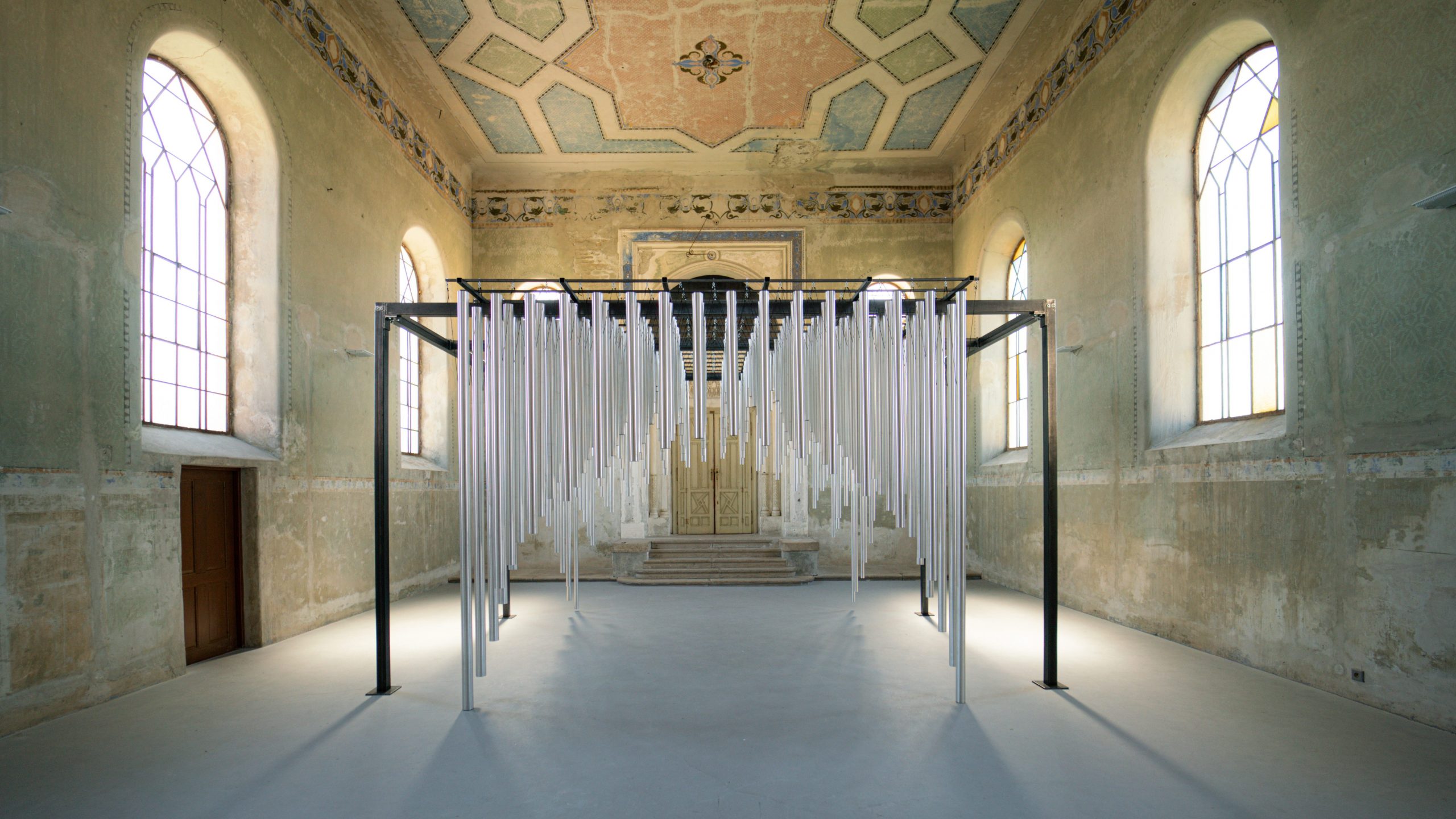
Today, this concept has taken on a physical presence. Austrian artist Josef Baier transformed the abstract matrix into a large-scale musical sculpture — a walk-in dome of precisely tuned tubes where harmonic relationships can be heard, felt, and explored directly.
Inside the structure, sound becomes spatial. Listeners and performers alike enter a field of resonance where mathematics is no longer abstract but perceptible through vibration and tone.
The Lambdoma stands at the intersection of art, science, and musical research. It offers a rare opportunity to experience harmony not only as theory, but as a physical and acoustic reality.
Whether approached from a cultural, artistic, or scientific perspective, the Lambdoma opens a space for listening, curiosity, and exploration.
The Sculpture ↗
…makes harmonic relationships perceptible.
The Lambdoma Matrix ↗
…formed the foundation of early music theory.